The Great Courses - Introduction to the Qur’an - Martyn Oliver, PhD
Shared by:ihophats
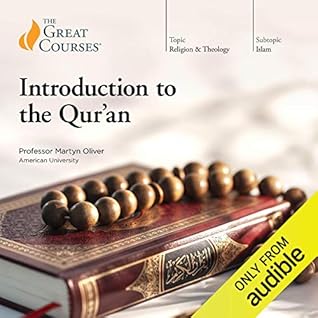
Written by ,
Read by Martyn Oliver, PhD
Format: MP3
Bitrate: 80 Kbps
Length: 5 hrs and 48 mins
Release date: 10-11-19
For people of the Muslim faith—nearly 25 percent of the world’s population—the Qur’an represents the most intimate and direct experience of the divine. For the Islamic faithful, the Qur’an is the eternal and perfect word of God, and it lies at the very heart of their understanding of themselves and the world. And yet, many non-Muslims have little familiarity with or understanding of this influential text. As a result, myths and misconceptions about the Qur’an and how it functions in the Islamic faith abound. In an increasingly global society, it has never been more important to understand the complicated history and message of the Qur’an, and its significance to millions of believers around the world.
Dr. Martyn Oliver, a Senior Professorial Lecturer at American University, presents the 12 in-depth lectures of Introduction to the Qur’an to provide you with a multifaceted approach to the Qur’an and its 1,400-year history, from its origins as a revelation to Muhammad in 7th-century Mecca to its role in the establishment and evolution of Islam as a world religion. Along the way, you will encounter characters familiar to those well-versed in the Judeo-Christian tradition—Adam and Eve, Moses and Abraham, Jesus and Mary—as well as concepts common across many world religions, like creation, sin, judgment, and the afterlife. You will also explore terms and ideas unique to the Islamic faith such as sharia and jihad, whose interpretations both beyond and within the Muslim world have led to questions and confusion.
Understanding any religious text from outside of its spiritual tradition is challenging and demands multiple perspectives. By combining literary, theological, and historical approaches to the Qur’an, Dr. Oliver provides a rich introduction to this influential text that both clarifies and adds important nuance our understanding of it. This course is also a rare opportunity to hear the Qur’an recited aloud by an award-winning reciter who brings the beautiful language of the ancient text to life for believers and the curious alike.
Text and Context
The year is around 571 C.E. and the small city of Mecca is thriving on the Arabian Peninsula, primarily as a result of the intersection of a broad range of religious and economic interests. Into this diverse and vibrant city is born a man, who by 610 C.E. has developed the habit of going outside the city walls on personal retreat. It is here, on one of these retreats, that Muhammad first hears a voice commanding him to “read aloud that which is written on your heart.” You will learn about Muhammad’s divine inspiration as well as his very human struggles in a society that was not always ready for the message he carried.
Specifically, you will:
Hear about the first moment of revelation, and Muhammad’s understandable fear that he may have been delusional;
Learn the words that Muhammad felt had been permanently inscribed upon his heart at that first revelation;
Discover who it was that Muslims believe spoke to Muhammad, and explore the key elements of this lengthy revelation, spanning some 22 years and two cities;
Explore the population to whom this message was meant to be delivered, and consider the rhetorical strategies used to best address the needs of that audience; and
Reflect on the role that Mecca—an economically and theologically diverse city—might have had on Muhammad, his followers, and ultimately his message.
Dr. Oliver’s course returns, again and again, to the man behind the message, and what we know and do not know about who he was and when and where he lived. Because Dr. Oliver approaches his study of the Qur’an as an influential piece of literature as well as an important religious text, he is able to help you understand that even the “perfected word of God” does not appear into a social vacuum. There is much-needed context if we want a truly thorough understanding of the text, its teachings, and its followers.
Although Muhammad was the messenger, and as such is much revered in the Islamic faith, he was never considered divine. It is the Qur’an, the revealed and perfect word of God that reaches believers via revelation through Muhammad that is considered most holy in the Islamic traditions. By giving his viewers insights into the parallels and significant differences between the Qur’an and the texts employed by other “People of the Book,” such as the Torah in Jewish tradition and the Bible for Christians, Professor Oliver helps us to see what connects all of these traditions—monotheism, devotion to God, a belief in the Last Judgment, stories of characters ranging from Moses and Abraham to Jesus and Mary—and what makes Islam particularly unique, most specifically, the belief that the Qur’an is God’s word made manifest in the world. As Dr. Oliver so succinctly states it, “For Christians, the Bible is the human vehicle through which is revealed the perfection that is Jesus; for Muslims, Muhammad is the human vehicle through which is revealed the perfection of God’s word, the Qur’an.”
Who Are the Believers?
Although the Word of God as manifested in the Qur’an is considered infallible by believers, the human capacity to understand and interpret that message most certainly is not. This course explores a number of different interpretive texts and traditions that have informed religious practice and thought within Islam across the 1,400 years since Muhammad received his revelation. Out of these many texts and developing theologies have come several schools, the names of which are often familiar—Sufi, Sunni, Shia, among others—but are less frequently understood well. Dr. Oliver takes you inside the philosophical and interpretive differences that inform these divides, explaining the multitude of ways in which the Qur’an, as a living text, is read and interpreted around the world. Most important, he helps us understand how specific differences in interpretation have led to differences in practice.
Not only was the message of the Qur’an brought into a complex and diverse social and economic environment in 7th-century Mecca, the message is arguably in the midst of an even more complicated world today. How does the voice of God continue to speak to millions of believers around the world right now? With the inclusion of a number of beautifully voiced recitations of the text in Arabic, Dr. Oliver affords his audience not only the opportunity to learn the content of important verses through his in-depth lectures, but also to hear the resonance of the words and the poetry of the phrases that can only be fully captured in the original Arabic.
Endings and Interpretations
Islam has three preeminent tenets—the singularity of God, the Final Day on which God will sit in judgment on the lives of every human being, and the importance of good works in winning God’s favor. With these in mind, explore with Dr. Oliver the Islamic conception of judgment and the afterlife, including the ideas of heaven and hell, both of which are literal and detailed in the Qur’an. You will:
Learn what other religious groups at the time believed about an afterlife;
Discover how the words of the Qur’an aligned with some aspects of Christian, Zoroastrian, and Jewish traditions about these ideas; and
Consider the ways in which specific aspects of the afterlife promised in the Qur’an reflect the values of Muhammad’s audience on the Arabian Peninsula.
It has been suggested that Dante’s famous vision of the afterlife, as presented in his three-part Commedia, might reflect descriptions originally recorded in the Qur’an. Certainly, there is evidence to suggest that the great Italian author was familiar with the words of Muhammad. The literal, sensual nature of both heaven and hell within the Qur’an brings to vivid life an understanding of the different potential outcomes—peace and pleasure, rewards unending in the company of God for those who believe, do good, and submit to God’s will, or a bottomless pit of pain and suffering for those who do wrong in the world.
Although many of the themes and characters in the Qur’an have much in common with the traditions of other “People of the Book”—Jews and Christians—the practice of Islam itself is unique. Much of that practice is guided by the Five Pillars of Islam: the statement of faith, prayer, charity, fasting, and pilgrimage to Mecca. And yet, these foundational practices are not fully explained in the Qur’an. By exploring how these practices came to be, Dr. Oliver guides you through the complicated world of Qur’anic interpretation. You’ll discover how Islamic scholars and theologians over the centuries have combined careful reading of the Qur’an with considerations of hadith (accounts of the practices of Muhammad) and sunnah (the customs of early Muslim communities) to inform the legal and spiritual practice of Islam in an ever-evolving world. In the closing lectures, you’ll learn how these interpretations have given birth to a variety of philosophical, theological, and mystical traditions that make Islam the rich, varied, and complex religion it is today.
Only by examining the historical, cultural, and religious framework of the Qur’an can we begin to understand the faith of one of the world’s largest religions. For those who practice Islam, this course may help believers better understand the history and evolution of the Qur’an and its role in Muslim practice, while those who come from the outside can have a better understanding of an often-misunderstood text. Introduction to the Qur’an will show you the beauty and the challenge of Muhammad’s revelation, and how it has moved its adherents for centuries.

| Announce URL: | |
| This Torrent also has several backup trackers | |
| Tracker: | udp://tracker.open-internet.nl:6969/announce |
| Tracker: | udp://tracker.opentrackr.org:1337/announce |
| Tracker: | udp://tracker.tiny-vps.com:6969/announce |
| Tracker: | udp://tracker.vanitycore.co:6969/announce |
| Tracker: | udp://tracker.torrent.eu.org:451/announce |
| Tracker: | http://tracker.internetwarriors.net:1337/announce |
| Tracker: | http://tracker.vanitycore.co:6969/announce |
| Tracker: | http://retracker.telecom.by/announce |
| Tracker: | udp://tracker.leechers-paradise.org:6969 |
| Tracker: | udp://tracker.coppersurfer.tk:6969 |
| Tracker: | udp://open.demonii.si:1337/announce |
| Tracker: | udp://thetracker.org:80/announce |
| Tracker: | http://tracker2.dler.org:80/announce |
| Creation Date: | Tue, 07 Jan 2020 16:20:25 +0000 |
| This is a Multifile Torrent | |
| 01 - Finding a Path into the Qur’an.mp3 17.1 MBs | |
| 02 - 7th-Century Mecca- Religion and Oral Tradition.mp3 13.32 MBs | |
| 03 - The Qur’an Becomes a “Book”.mp3 20.43 MBs | |
| 04 - From Mecca to Medina- The Revelation Transforms.mp3 14.23 MBs | |
| 05 - God and Tawhid- Divine Nature in the Qur’an.mp3 20.63 MBs | |
| 06 - The Qur’anic Creation Story.mp3 15.54 MBs | |
| 07 - Judgment Day and the End Times- Yawm ad-Din.mp3 14.47 MBs | |
| 08 - Abraham, Moses, and Qur’anic Faith.mp3 16.08 MBs | |
| 09 - Prophethood in the Qur’an- Jesus and Others.mp3 15.52 MBs | |
| 10 - From the Qur’an to Islam- Creating a Practice.mp3 16.81 MBs | |
| 11 - Sharia and Jihad- The Qur’an as Legal Text.mp3 14.95 MBs | |
| 12 - Qur’anic Philosophy, Theology, and Mysticism.mp3 23.12 MBs | |
| Combined File Size: | 202.2 MBs |
| Piece Size: | 128 KBs |
| Comment: | Updated by AudioBook Bay |
| Encoding: | UTF-8 |
| Info Hash: | 01a36ad7313badf0e5be72c5612acb5605c48af0 |
| Torrent Download | Torrent Free Downloads |
| Tips | Sometimes the torrent health info isn’t accurate, so you can download the file and check it out or try the following downloads. |
| Direct Download | Start Direct Download |
| Tips | You could try out alternative bittorrent clients. |
| Secured Download | Download Files Now |
| Ad |

|






This post has 12 comments with rating of 4/5
January 7th, 2020
Thank you for this interesting share!
January 8th, 2020
A lot of Iranians are about to find out if its true or not
January 8th, 2020
So are a lot of Americans flarecat777 you clown.
January 8th, 2020
May as well have a book titles “An Introduction to Mein Kampf”.
What this “great course” doesn’t do is mention Muhammad’s deeds of polygamy, pedophilia (with nine-year old Aisha), and beheading the Bani Quraiza Jews.
January 8th, 2020
Muhammad is a deeply problematic figure - to say the very least - but it’s great to get such an assessment of the Qur’an.
Trump seems to have extended the orange branch (at least I think that’s what he extended) to the Persians - now that he’s succeeded with the ole Clintonian, wag the dog, Machiavellian maneouvre of death.
January 10th, 2020
Prophet Muhammed was a great man and a reformer. Plz read more about him.
January 30th, 2020
Thanks for this, will take a listen.
Bible and Torah has child marriages and terrorism, hopefully no hypocrites here complaining about Islam, whilst overlooking their own books.. lol
I admire the fact a chapter in Qur’an is named ‘Divorce’ , a concept Western minds couldn’t fathom, as man was superior to woman according to Bible.
A book well ahead of its time, when it comes to social justice.
Women only got right of divorce in western world recently.
equality, lol, edom at it again…
February 24th, 2020
Islam & women’s rights? Really? Best to let that one “lie.”
The Old Testament depicts Israel failing to abide by the Covenant. That is its point & purpose - that is its truth & painful honesty.
Each divorce is a tragedy - a catastrophe for a family, hardly something to celebrate, no matter the institutional system or geographic location.
St Paul wrote that there is no man or woman, for all are equal & one in Christianity (”nor is there male and female,” hearkening back to Gen 1).
He also said that, in marriage & in terms of sexual love, the woman’s body belongs to the man, just as the man’s body belongs to the woman. Marriage is a serious commitment, not to be embarked upon lightly, like just another superficial feature of our disposable, consumer culture of objectification (she/he is becoming old/obsolete, time to replace “it” with the new model!).
In addition to the sacred position of the woman qua mother in Western civilisation, tradition & culture - Christianity, based on the concept of the freedom of the will, introduced the central convention of public, witnessed, express consent to marriage, for the woman & the man. This was to ensure that the woman’s choice was free & uncoerced, as it had been pre-Christianity. Such marriage would be false & a dead letter, in every sense.
As far as culture & morality, all people, at all times, in all places & traditions, fall very short of the ideal. Welcome to humanity. Everyone is a hypocrite, at one point or another; and at all points of the compass.
April 29th, 2020
Why is it in the non-fiction section? O.o I’m confused now.
May 3rd, 2020
I enjoy The Great Courses audiobook lectures, thank you to the sharer!
I’ve been here on ABB for years. Love the TGC & lots of the other history lecture courses. What’s happening with all these conspie alt-right or loony-left comments everywhere recently?
GO AWAY *all* of you political types and leave us audio nerds to our history and audiobooks and Doctor Who. Thank you kindly.
October 22nd, 2025
Thank you.
July 24th, 2026
It’ll be interesting to contrast this history with Robert Spencer’s excellent Did Muhammad Exist book.
Add a comment (please log in before commenting)